





Obszary badawcze:
– Synteza naturalnych modyfikacji RNA, w szczególności tio- i selenopochodnych urydyny oraz ich analogów, wykorzystywanych jako związki referencyjne do badań analitycznych i strukturalnych, w tym identyfikacji modyfikacji RNA metodami spektrometrii mas oraz analiz fizykochemicznych. (Badania realizowane we współpracy z ośrodkami naukowymi w Polsce i za granicą).
– Poszukiwanie nowych modyfikowanych nukleozydów w tRNA, identyfikacja szlaków biosyntezy modyfikowanych nukleozydów, badanie wpływu tio- i selenourydyn na podatność tRNA na uszkodzenia w warunkach stresu oksydacyjnego.
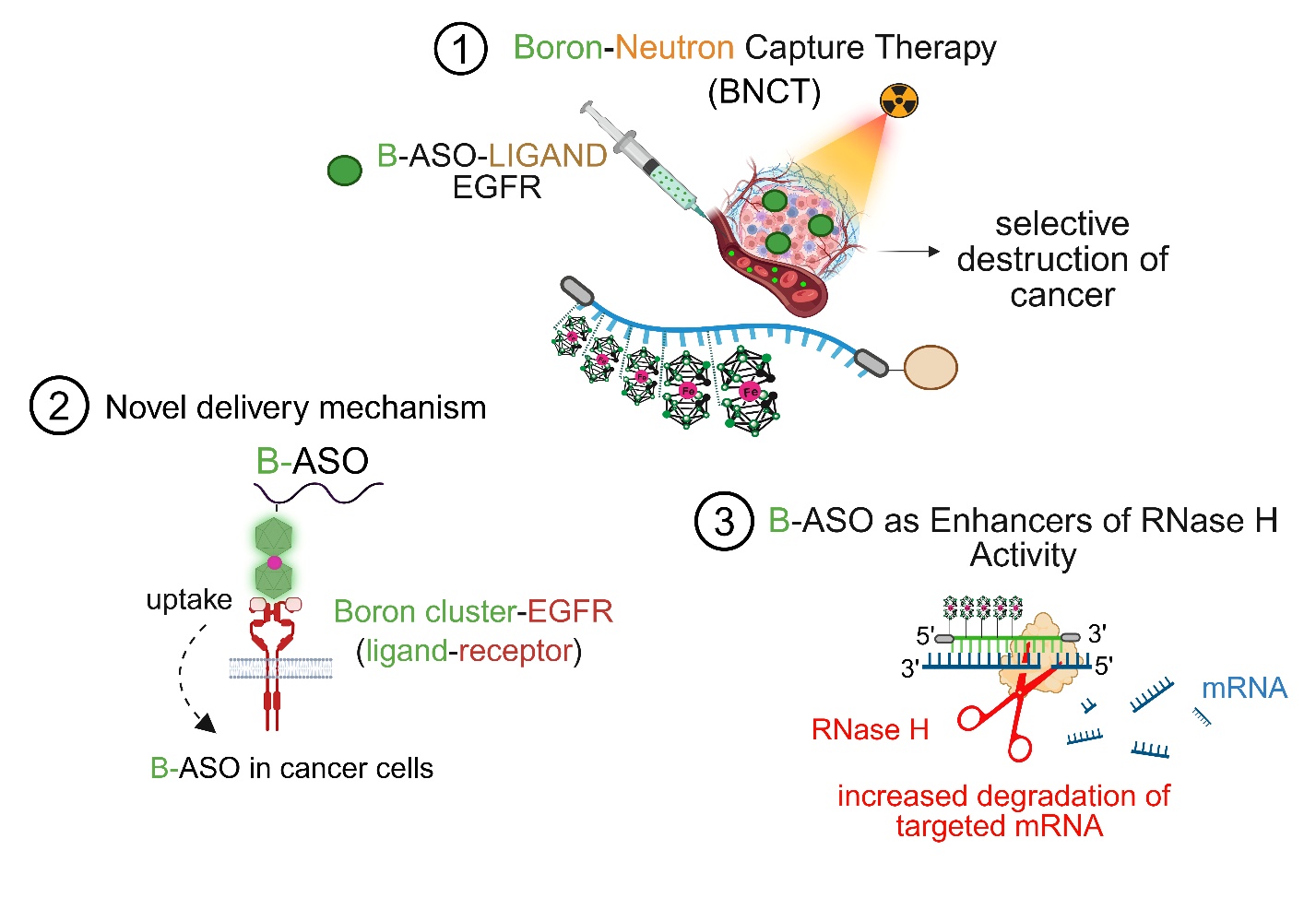
Figura 1. Koniugaty antysensowych kwasów nukleinowych modyfikowanych klastrami boru oraz selektywnymi ligandami (B-ASO-LIGANDY) do radioterapii borowo-neutronowej (ang. BNCT) (1); Mechanizm selektywnego dostarczania B-ASO do komórek nowotworowych za pomocą odziaływania klastra boru jako liganda z naskórkowym receptorem wzrostu (ang. EGFR) (2); Zwiększanie aktywności endonukleazy (ang. RNase H) przez B-ASO w celu skutecznego niszczenia wybranego fragmentu matrycy mRNA jako terapia genowa (3).
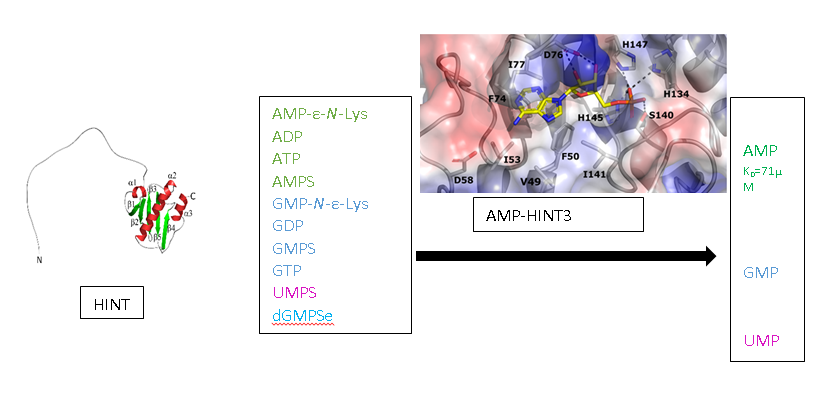
Figura 2. Struktura i funkcja białka HINT3:
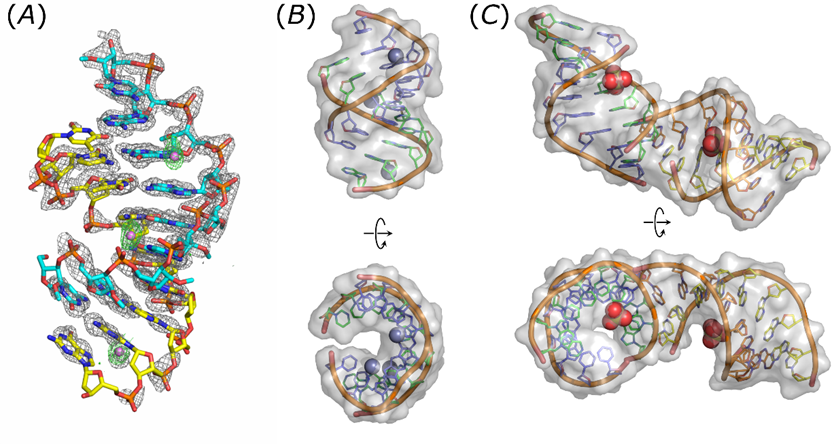
Figura 3. Struktura krystaliczna dupleksów DNA:2’-OMe-RNA: (A) Wstępna konturowa mapa gęstości elektronowej (2FO-FC) i mapa rozpraszania anomalnego z udokładnioną strukturą dupleksu z overhangami z Zn2+; Struktura cząsteczkowa dupleksów DNA:2’-OMe-RNA z overhangami (B) i tępymi końcami (C).
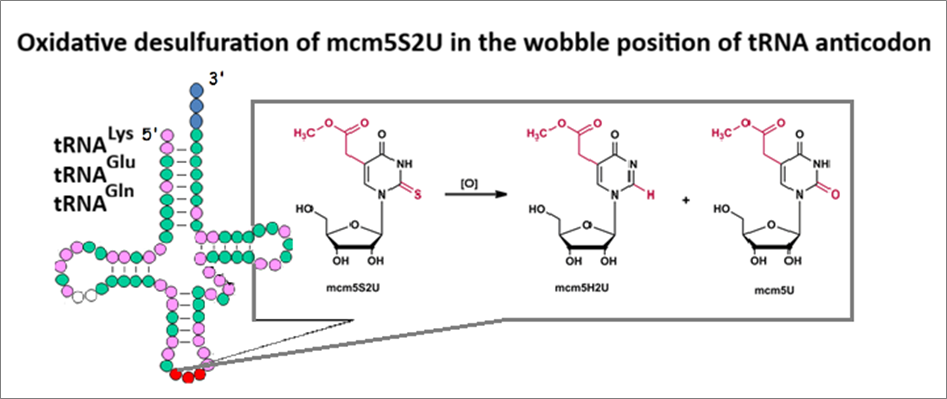
Figura 4. Oxidative desulfuration of mcm5S2U in the wobble position of tRNA found in and human cells.
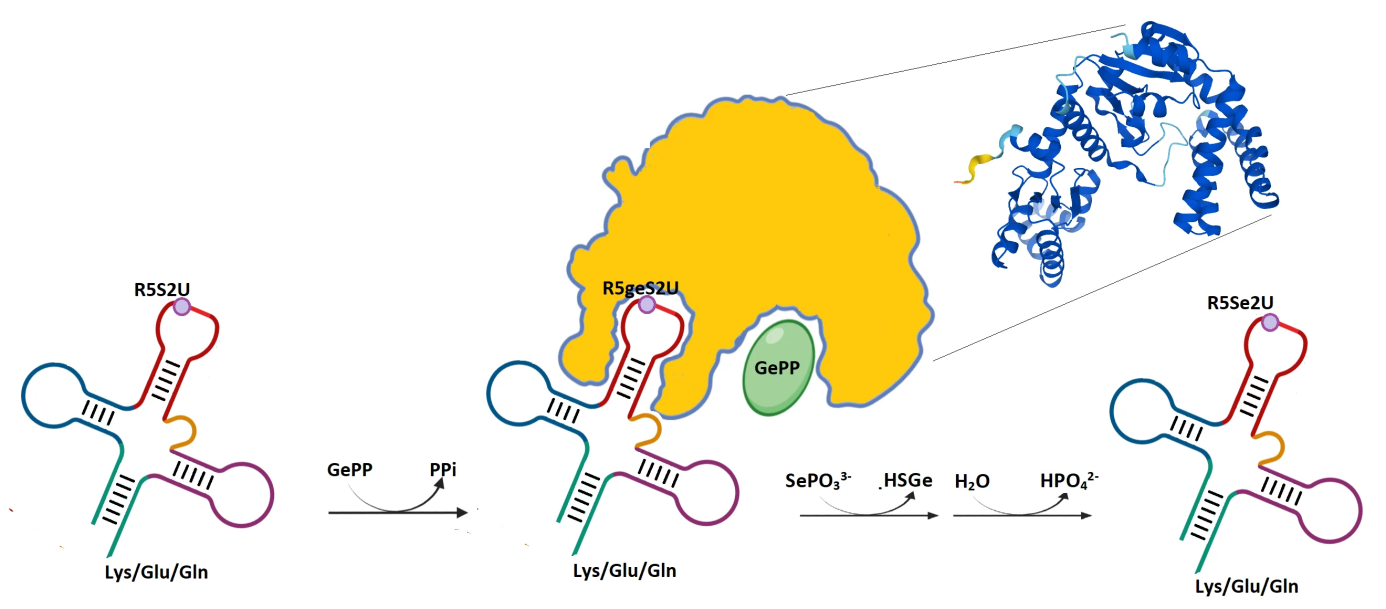
Figura 5. SelU catalyzes conversion of 2-thiouridine-tRNA (R5S2U-tRNA) to 2-selenouridine-tRNA (R5Se2U-tRNA) via S-geranyl-tRNA (R5geS2U-tRNA), the intermediate closely bound to the enzyme.
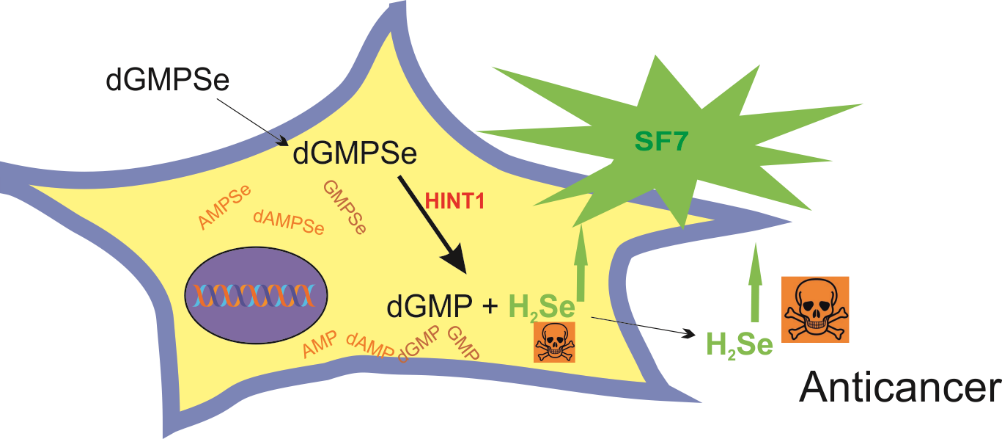
Figura 6. Katalizowane za pomoca białka HINT-1 dGMPSe do dGMP i H2Se.
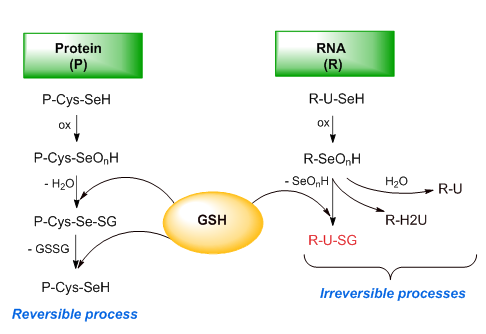
Figura 7. Odmienne zachowanie selenu podczas utleniania w białkach zawierających selenocysteinę oraz w RNA zawierającym 2-selenourydynę w obecności glutationu. Utlenianie Se2U-RNA prowadzi do powstawania trwałych pochodnych stabilizujących RNA, w przeciwieństwie do odwracalnej redukcji utlenionych reszt białkowych przez glutation.
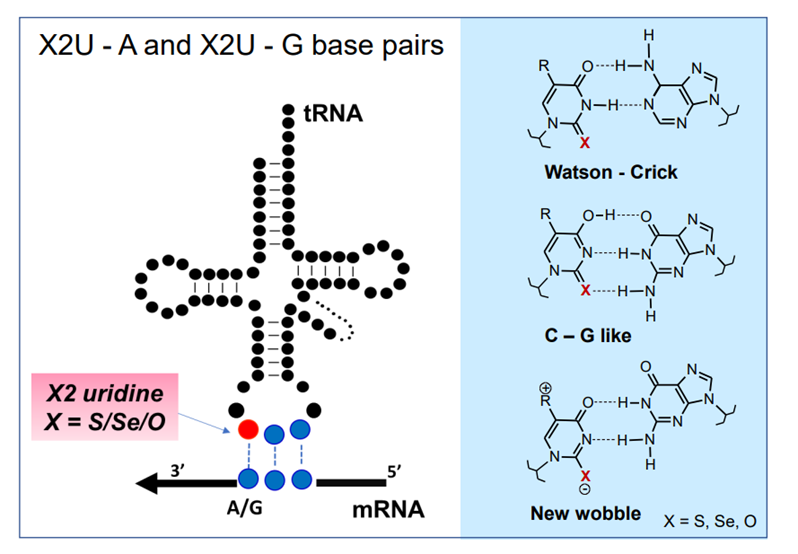
Figura 8. Schemat przedstawia parowanie zasad X2U–A oraz X2U–G w obrębie antykodonu tRNA, gdzie modyfikacje w pozycji 2 urydyny (X = O, S, Se) wpływają na sposób rozpoznawania kodonów mRNA. Obecność atomu siarki lub selenu w pozycji wobble stabilizuje interakcje stackingowe i sprzyja tworzeniu zarówno klasycznych par Watsona-Cricka, jak i alternatywnych par typu C–G-like oraz nowych oddziaływań wobble, zwiększając efektywność dekodowania kodonów.
Preclinical Evaluation of a Bispecific Therapeutic Nucleic Acid Modified with Boron Cluster for Cancer Treatment in an in ovo Model
Kierownik projektu: dr Damian Kaniowski
Grant NCN SONATA 21 (2026-2029)
Opis projektu
Opracowanie metody analitycznej opartej na spektrometrii mas do wykrywania i ilościowego oznaczania tio- i selenonukleozydów w tRNA.
Kierownik projektu: dr Katarzyna Sylwia Kulik
Grant NCN Miniatura 9 (2025-2026)
Opis projektu
Nowa klasa oligonukleotydów DNA modyfikowanych klastrami boru w obrębie wiązań internukleotydowych.
Kierownik projektu: dr inż. Katarzyna Ebenryter-Olbińska
Grant NCN, Miniatura 8 (2025-2026)
Opis projektu
Nowy lek przeciwnowotworowy w oparciu o RNA. Część I – Uzyskanie dowodu koncepcji (proof of concept), że lipopleksy opracowane przez BS Biotechna mają zastosowanie w terapii opartej na RNA (na modelu siRNA anty-EGFR)
Kierownik projektu: prof. dr hab. Barbara Nawrot
Projekt ABM – Współpraca z firmą BS Biotechna (2023-2028)
Badania powinowactwa kompleksu białkowego RISC/Ago-2 do terapeutycznych kwasów nukleinowych siRNA EGFR dekorowanych klastrami boru – ocena aktywności przeciwnowotworowej
Kierownik projektu: dr Justyna Suwara
Grant NCN Miniatura 5 (2021-2022)
Oligonukleotydy antysensowe i ich nanostruktury skoniugowane z klastrami boru; charakterystyka fizykochemiczna i biologiczna – próby oszacowania potencjału badanych związków do zastosowania w terapii BNCT
Kierownik projektu: dr Damian Kaniowski
Grant NCN, ETIUDA 8 (2020-2023)
Opis projektu
Dlaczego Natura wprowadziła selen do nukleozydów w pozycji wahadłowej bakteryjnych tRNA?
Kierownik grantu: prof. dr hab. Barbara Nawrot
Grant NCN OPUS 15 (2018-2022)
Opis projektu
Badanie uszkodzeń 2-tiourydyno-tRNA zachodzących w komórkach poddanych stresowi oksydacyjnemu.
Kierownik grantu: dr Małgorzata Barbara Sierant
Grant NCN, OPUS 12 (2017-2022)
Opis projektu
Oligopodalne kompozyty kwasów nukleinowych i klasterów boru – nowy materiał dla bionanotechnologii
Konsorcjum z IBM – Lider: Zbigniew Leśnikowski
Kierownik: prof. dr hab. Barbara Nawrot
Grant NCN SYMFONIA 3 (2015-2022)
Opis projektu
Biosynteza seleno-modyfikowanych nukleozydów w pętli antykodonu transferowych kwasów rybonukleinowych. Ewaluacja enzymatycznej transformacji 2-tiourydyny do 2-selenourydyny, badania funkcji i struktury tRNA selenourydyno syntazy z E. coli.
Kierownik grantu prof. dr hab. Barbara Nawrot
Grant NCN, UMO-2014/13/B/ST5/03979 (2015-2018)
Opis projektu
Transformacja 5′-O-monotiofosforanów nukleozydów do odpowiednich 5′-O-monofosforanów w warunkach komórkowych – możliwa droga metaboliczna tiofosforanowych leków i proleków.
Kierownik grantu dr hab. Agnieszka Krakowiak
Grant NCN, OPUS nr 2013/09/B/ST5/03612 (2014-2017)
Opis projektu
Rozwiązanie struktury krystalicznej deoksyrybozymu 10-23 i wyjaśnienie mechanizmu jego działania
Kierownik grantu: dr inż. Rafał Dolot
Grant NCN OPUS 3 (2013-2016)
Opis projektu
Badania desulfuracji 2-tiourydyn w kontekście uszkodzeń tRNA w warunkach stresu oksydacyjnego
Kierownik projektu: prof. dr hab. Barbara Nawrot
Współpraca: prof. dr hab. Elżbieta Sochacka (Politechnika Łódzka)
Projekt NCN OPUS (2012-2015)
Opis projektu
Badania strukturalne białek triady histydynowej wiążących nukleotydy HINT2 i HINT3
Kierownik grantu: dr inż. Rafał Dolot
Grant MNiSW Nr N N204 516139 (2010-2013)
Opis projetu
Metabolizm tiofosforanowych leków i proleków – identyfikacja białek wiążących 5’-monotiofosforany nukleozydów z zastosowaniem metody fotozszywania.
Kierownik grantu dr hab. Agnieszka Krakowiak
Grant KBN No: NN204130137 (2009-2012)
Opis projektu
Granty dla młodych naukowców:
Dr Damian Kaniowski: Wpływ klastrów boru na aktywność endonukleazy RNase H: innowacyjne strategie terapii opartej na kwasach nukleinowych (2025-2026)
mgr Patrycja Szczupak: Badanie elementów rozpoznawania substratów do prenylowania S2U-RNA oraz prenylowych-RNA przez 2-selenourydyno syntazę tRNA. (2020)
mgr Damian Kaniowski: Identyfikacja i charakterystyka białek komórkowych wiążących się do modelowych koniugatów azydków boranowych z biotyną. (2020)
Dr Katarzyna Ebenryter-Olbińska: Synteza koniugatów kwasów nukleinowych i klasterów boru funkcjonalizowanych cząsteczkami fluoresceiny, galaktozaminy oraz biotyny. (2020)
Dr Ewa Radzikowska-Cieciura: Identyfikacja elementów odpowiedzialnych za rozpoznanie substratu przez enzym tRNA 2-selenourydyno syntazę (SeIU) z E. coli podczas katalizowanej przez SeIU reakcji selenowania prowadzącej do przekształcenia odpowiedniego prenylowego-tRNA do Se2U-tRNA (2020)
mgr Damian Kaniowski: Zbadanie aktywności hydrolitycznej 3’- i 5’-egzonukleaz w obecności oligonukleotydów antysensowych (ASO) dekorowanych klastrami boru. (2018-2019)
1. K. Kulik, E. Wielgus, M. Cocchioni, H. Kovács, É.A. Enyedy, A. Maciaszek, B. Nawrot, Mechanistic Insights into the Oxidative Reactivity of 2-Selenouridine in tRNA . Chemistry – A European Journal, 2026. IF 3,8
2. P. Kuwerska, K. Bartosik, K. Kulik, A. Dziergowska, J. Jakubowska, B. Nawrot, G. Leszczynska, Synthesis and Hybridization Properties of RNA Oligomers Containing Biologically Relevant 5-Aminomethyl-2-thiouridines (xnm5S2U). Curr. Med. Chem, 2026, 33, 11, IF 4.0
3. P. Kuwerska, K. Kulik, K. Podskoczyj, A. Dziergowska, E. Sochacka, T. Bartosik, M. Sierant, B. Nawrot, G. Leszczynska, From U to mnm⁵Se²U: tuning base pairing preferences through 2-chalcogen and 5-methylaminomethyl modifications”, Scientific Reports, 2026, IF 4.3
4. Katarzyna Kulik and Barbara Nawrot, Uridines Modified with Sulfur or Selenium in U-G Wobble Pairs Matter for tRNA Function, Curr. Med. 33 (11), 2026, 2087 – 2110 , DOI: 10.2174/0109298673367883250716201037
5. H. Rostkowska, K. Kulik, A. Luchowska, L. Lapinski, B. Nawrot, M. J. Nowak. UV-induced transformations and spontaneous hydrogen-atom tunneling in 2-selenouracil isolated in low-temperature Ar matrices. Spectrochimica Acta Part A: Molecular and Biomolecular Spectroscopy, 2026, 344, 1, 126597, IF 4.3
6. K. Pierański, D. Kaniowski, P. Szweda Therapeutic Potential of Propolis in Preclinical Models of Cancer and Infectious Diseases: A Review. Int. J. Mol. Sci. 2025, 26(16), 8041, IF 5.7
7. A. Krakowiak, Sulfur and Selenium Modifications at Phosphorus Atom in Nucleoside Monophosphates, Activity and Potential Applications; Curr. Med Chem. 2025 Apr 28 (Online ahead of print). doi: 10.2174/0109298673361335250404171911; IF 4.0
8. T. Baker, C. J. Kidman, L.I. Vogt, G.N. George, D. Sokaras, D. L. Howard, V. F.S. Pape, K. Kulik, S. Yoshida, H. H. Harris, Selenium Distribution and Speciation in Tissues from Rats Administered with Non-Native Selenotrisulfides, Inorganic Chemistry, 2025, 64, 20, 9961–9983, IF 4.3
9. K. Śmiałkowski, K. Bednarska-Szczepaniak, K. Kulik, J. Suwara, B. Grűner, A. Foryś, B. Nawrot, Z. J. Leśnikowski, Synthesis of Composites of DNA and Boron Cluster‐Metal Complexes and Their Assembly Into Functional Nanoparticles with Gene Silencing Activity. ChemNanoMat, 11, 3, 2025, e202400606, IF 2.8
10. D. Kaniowski, K. Ebenryter-Olbińska, J. Suwara, K. Kulik, J. Hall, D. Wang, E. Y. Kang, R. Dolot, A. Somenzi, A. Jakóbik-Kolon, N. Protti, S. Altieri, M. Kortylewski, B. Nawrot, EGFR-targeted antisense oligonucleotides modified with boron clusters offer an innovative approach to cancer chemo-radiotherapy, bioRxiv 2025.08.07.668562 – preprint
11. R. Dolot, M. Sierant, A. Mikołajczyk, R. Kaczmarek, B. Nawrot, A. Krakowiak, Biochemical and biophysical characterization, and 3D structure modeling of human HINT3, a hydrolase of the HIT superfamily . Bioorg. Chem. 2025 Nov, 166, (109115-109130). doi: 10.1016/j.bioorg.2025.109115, IF 4,9
12. Jeziorna, M. Malińska, I. Sugden, P. Paluch, R. Dolot, M.K. Dudek, scXRD, CSP-NMRX and microED in the quest for three elusive polymorphs of meloxicam. IUCr J. 2025, 12, 109-122; IF= 3.7
13. A. Rzewnicka, M. Mikina, J. Krysiak, T. Makowski, M. Svyntkiska, R. Dolot, D. Płażuk, G. Bujacz, R. Żurawiński. Exploring benzotieno[3,2-b][1]benzotiophene S-oxides for organic electronics, fluorescence-based applications, and asymmetric synthesis. Chem. Eur. J. 2025, 11 (e202403912) IF 3.8
14. M. Dillenburg, C.D. Peterson, R. Dolot, K. Ligori, K.F. Kitto, G.L. Wilcox, C.A. Fairbanks, C.R. Wagner, HINT1 inhibitors as selective modulators of MOR-NMDAR cross regulation and non-opioid analgesia. ACS Chem. Neurosci. 2025, 16, 604-618, IF 4.0
15. S. Lechner, S. Sha, J.P. Sethiya, R. Dolot, P. Szczupak, S. Lomada, A. Sakhteman, J. Tushaus, P. Prokofeva, F. Breu, K. Voegerl, M. Morgenstern, German Mouse Clinic Consortium, M.H. de Angelis, T. Wieland, C. Wagner, G. Médard, F. Bracher, B. Kuster. Serendiptious and systematic chemoproteomic discovery of MBLAC2, HINT1, and NME1-4 inhibitors from HDAC-targeting pharmacores. ACS Chem. Biol. 2025, 20, 1247-1257, IF 4.1
16. A. Walkiewicz-Pietrzykowska, K. Jankowski, J. Kurjata, R. Dolot, R. Brzozowski, J. Zakrzewska, P. Uznański, Silicon oxycarbide thin films produced by hydrogen-induced CVD process from cyclic dioxa-tetrasilacyclohexane. Materials, 2025, 18, 2911, IF 3.5
17. P. Woliński, A. Kącka-Zych, E. Wielgus, R. Dolot, R. Jasiński, Analysis of the reactivity of Z-2-Ar-1-EWG-1-nitroethene molecular segment in the hetero Diels-Alder reaction: experimental and MEDT quantum chemical study. Molecules, 2025, 30, 3768, IF 5.0
18. K. Jastrzębska, A. Szymańska, T. Pawlak, R. Dolot; Novel morpholino-based phosphorothioate chemistry: synthesis, structural insights and stability. Org. Biomol. Chem. 2025, 23, 8755-8763, IF 2.9
19. R. Dolot, M. Sierant, A. Mikołajczyk, R. Kaczmarek, B. Nawrot, A. Krakowiak, Expression, biochemical characterization and structure modelling of human histidine triad nucleotide-binding protein 3, a hydrolase of the HIT superfamily. Bioorg. Chem. 2025, 166, 109115, IF = 4.9
20. P. Paluch, A. Jeziorna, R. Dolot, K. Drużbicki, M. Potrzebowski. From amorphous bundles to nanoporous molecular frameworks: solvent-driven self-assembly of a Pro-Val-Pro-Val tetrapeptide. Biomacromolecules 2025– dostępna on-line. IF = 5.8
21. M. Gosecki, M. Gosecka, M. Urbaniak, R. Dolot, A. Rosiak. Non-Catalytic Hydrolysis of Epoxidized Castor Oil: A Sustainable Route to Diol-Rich Polyols and Recyclable Polyboronates. ChemPlusChem 2025, IF = 3.0
22. Renata Kaczmarek, Ewa Radzikowska- Cieciura, Karolina Królewska-Golińska, Graciela Andrei, Robert Snoeck, Rafał Dolot, Kraig A. Wheeler, Dominic Agyei Gyimah, Susan Yang, Roman Dembinski. Comparison of Free-Hydroxy With 3,5-Di-O-AcetylRibose of 5-Alkynyl Dicobalt Hexacarbonyl 2’-Deoxy-Furopyrimidines Hybrids: Synthesis, Antiproliferative Activity, and ROS Determination. Applied Organometallic Chemistry, 2024; 0:e7695
23. K. Bednarska-Szczepaniak K, Ebenryter-Olbińska K, Gajek G, Śmiałkowski K, Suwara J, Fiedorowicz L, Leśnikowski Z. Synthesis of DNA-Boron Cluster Composites and Assembly into Functional Nanoparticles with Dual, Anti-EGFR, and Anti-c-MYC Oncogene Silencing Activity. Chemistry – A European Journal. 2024 Mar 7;30(14):e202303531. doi: 10.1002/chem.202303531.
24. Sierant M, Szewczyk R, Dziergowska A, Krolewska-Golinska K, Szczupak P, Bernat P, Nawrot B. Studies on the Oxidative Damage of the Wobble 5-Methylcarboxymethyl-2-Thiouridine in the tRNA of Eukaryotic Cells with Disturbed Homeostasis of the Antioxidant System. Int J Mol Sci. 2024 Nov 17;25(22):12336. doi: 10.3390/ijms252212336. IF 4.9, Q1,
25. Jastrzębska K., Antończyk P., Dolot R. Synthesis and stereochemistry of P-stereodefined morpholino dinucleoside 3’,6’-phosphorothioates. Org. Biomol. Chem. 22, (8737-8742)
26. Rzewnicka A., Dolot R., Mikina M., Krysiak J., Żurawiński R. Modulation of properties in [1]Benzotieno[3,2-b][1]benzotiophene derivatives through sulfur oxidation. Molecules, 29, (3575)
27. Potrzebowski M.J., Bąk-Sypień I., Pawlak T., Paluch P., Wróblewska A., Dolot R., Pawłowicz A., Szczesio M., Wielgus E., Kaźmierski S., Górecki M., Pawłowska R., Chworoś A. Influence of heterochirality on the structure, dynamics, biological properties of cyclic(PFPF) tetrapeptides obtained by solvent-free ball mill mechanosynthesis. Rep. 14, (12825)
28. Suwara J., Kulik K, Kaniowski D., Ebenryter-Olbińska K., Jakóbik-Kolon A., Maciaszek A., Nawrot B. (2023). Silencing activity of boron cluster-enriched siRNA: a thriving world of possibilities for combined gene therapy and BNCT. FEBS Open Bio, 13: P-03.2-14. doi:10.1002/2211-5463.13646 IF 2,792
29. Szczupak P, Radzikowska-Cieciura E, Kulik K, Madaj R, Sierant M, Krakowiak A, Nawrot B. „Studies on the affinity of the bacterial 2-selenouridine-tRNA synthase (SelU) enzyme for its prenyl pyrophosphate substrates”. Acta Biochimica Polonica, 2023 Vol. 70 No. S2: P.06.10 IF 2,349
30. K. Kulik, P. Kuwerska, K. Podskoczyj, A. Dziergowska, E. Sochacka, G. Leszczynska, B. Nawrot, The importance of sulfur and selenium atoms in wobble uridines of bacterial tRNAs for reading NNA- and NNG-3′-ending codons; the thermodynamic stability of RNA duplexes with S2U and Se2U modifications, Acta Biochimica Polonica, Vol. 70 No. S2 (2023) IF 2,349,
31. Nawrot B, Sierant M, Szczupak P. Sulfur and Selenium modified bacterial tRNAs. In: Sugimoto, N. (eds) Handbook of Chemical Biology of Nucleic Acids. Springer, Singapore. (2023). https://doi.org/10.1007/978-981-16-1313-5_43-1
32. Krakowiak A, Pietrasik S, New Insights into Oxidative and Reductive Stress Responses and Their Relation to the Anticancer Activity of Selenium-Containing Compounds as Hydrogen Selenide Donors, Biology (2023), 12, 875. https://doi.org/10.3390/biology12060875. IF=5.168 (2021);
33. P. Woliński, A. Kącka-Zych, A. Wróblewska, E. Wielgus, R. Dolot, R. Jasiński. A unique example of the fully selective synthesis of spirocyclic-1,2-oxazine N-oxides via non-catalysed Hetero Diels-Alder reactions with the participation of cyanofunctionalysed conjugated nitroalkenes. 2023, Molecules, 28, (4586).
34. R. Kaczmarek, E. Radzikowska-Cieciura, K. Królewska-Golińska, R. Dolot, K. Wheeler, F. Chavez, R. Dembinski. Synthesis and Determination of Anticancer Activity of Dicobalt Hexacarbonyl 2′-Deoxy-5-Alkynylfuropyrimidines. 2023, ACS Med. Chem. Lett. 14, (962-969).
35. R. Dolot, A. Mikołajczyk, B. Nawrot. Crystal packing differences as a key factor for stabilization of the N-terminal fragment of the human HINT1 protein. 2023, Crystals, 13, (1197).
36. A. Jeziorna, P. Paluch, J. Zając, R. Dolot, M.K. Dudek. Crystallization of meloxicam elusive polymorphs informed by crystal structure prediction (CSP). 2023, Cryst. Growth Des. 23, (5998-6010).
37. Suwara J, Radzikowska-Cieciura E, Chworos A, Pawlowska R.; The ATP-dependent pathways and human diseases. Curr Med Chem. 2022 Mar 22. IF 4,53;
38. Kaniowski D., Kulik K., Suwara J., Ebenryter-Olbińska K., Nawrot B.; Boron clusters as enhancers of RNase H activity in the smart strategy of gene silencing by antisense oligonucleotides. Int. J. Mol. Sci. 2022, 23, 12190. IF 6,2;
39. Kaniowski D., Suwara J., Ebenryter-Olbińska K., Jakóbik-Kolon A., Nawrot B.; EGFR-targeted cellular delivery of therapeutic nucleic acids mediatd by boron clusters. J. Mol. Sci. 2022, 23, 14793. IF 6,2;
40. Suwara J.: Powrót do przeszłości: nowe życie starych leków w terapiach antynowotworowych dzięki wykorzystaniu nowoczesnych systemów ich dostarczania. W: Choroby XXI wieku – diagnostyka, prewencja i leczenie.; red. Alicja Danielewska, Izabela Mołdoch-Mendoń. Wydawnictwo Naukowe TYGIEL sp. z o.o. Lublin 2022: 87-100.
41. Szczupak P, Sierant M, Wielgus E, Radzikowska-Cieciura E, Kulik K, Krakowiak A, Kuwerska P, Leszczynska G, Nawrot B. Escherichia coli tRNA 2-Selenouridine Synthase (SelU): Elucidation of Substrate Specificity to Understand the Role of S-Geranyl-tRNA in the Conversion of 2-Thio- into 2-Selenouridines in Bacterial tRNA. 2022 May 2;11(9):1522. doi: 10.3390/cells11091522
42. Szczupak P, Radzikowska-Cieciura E, Kulik K, Madaj R, Sierant M, Krakowiak A, Nawrot B. Escherichia coli tRNA 2-selenouridine synthase SelU selects its prenyl substrate to accomplish its enzymatic function. Bioorg Chem. 2022 May;122:105739. doi: 10.1016/j.bioorg.2022.105739
43. Kulik, K.; Sadowska, K.; Wielgus, E.; Pacholczyk-Sienicka, B.; Sochacka, E.; Nawrot, B, 2-Selenouridine, a Modified Nucleoside of Bacterial tRNAs, Its Reactivity in the Presence of Oxidizing and Reducing Reagents; Int. J. Mol. Sci. 2022, 23(14), 7973
44. Krakowiak A, Czernek L, Pichlak M, Kaczmarek R. Intracellular HINT1-Assisted Hydrolysis of Nucleoside 5′-O-Selenophosphate Leads to the Release of Hydrogen Selenide That Exhibits Toxic Effects in Human Cervical Cancer Cells. Int J Mol Sci. 2022, 23: 607-624.
45. Stukan I., Gryzik M., Hoser G., Want A., Grabowska-Pyrzewicz W., Zdioruk M., Napiórkowska M., Cieślak M., Królewska-Golińska K., Nawrot B., Basak G., Wojda U. Novel Dicarboximide BK124.1 Breaks Multidrug Resistance and Shows Anticancer Efficacy in Chronic Myeloid Leukemia Preclinical Models and Patients’ CD34+ /CD38− Leukemia Stem Cells. Cancers, 2022, 14, 3641
46. Strom A., Shah R., Dolot R., Rogers M.S., Tong C.-L., Wang D., Xia Y., Lipscomb J.D., Wagner C.R. Dynamic long-range interactions influence substrate binding and catalysis by human histidine triad nucleotide-binding proteins (HINTs), key regulators of multiple cellular processes and activators of antiviral ProTides. (2022) Biochemistry, 61, 2648-2661. (IF2021=3.321, 5year=3.261,
47. Jastrzębska K., Maciaszek A., Dolot R., Tomaszewska-Antczak A., Mikołajczyk B., Guga P. Synthesis and hybrydizing properties of P-stereodefined chimeric [PS]-{DNA:RNA} and [PS]-{DNA:(2’-OMe)-RNA} oligomers. (2022) RSC Adv. 12, 26815-26824. (IF2021=4.036, 5year=3.748,
48. Pawlak T., Paluch P., Dolot R., Bujacz G., Potrzebowski M.J. New salts of teriflunomide (TFM) – Single crystal X-ray and solid state NMR investigation. (2022) Solid State Nucl. Magn. Reson. 122, 101820. (IF2021=2.812, 5year=2.389,
49. Chotera-Ouda A., Jeziorna A., Kaźmierski S., Dolot R., Dudek M., Potrzebowski M. „Crystal memory” affects the properties of peptide hydrogels – the case of the cyclic Tyr-Tyr dipeptide. (2022) Chem. Eur. J. 28, e202202005 (IF2021=5.020, 5year=4.822,
50. Dolot R., Maciaszek A., Mikołajczyk B., Nawrot B. First high-resolution crystal structures of DNA:2’-O-methyl-RNA heteroduplexes. (2022) Crystals (Basel), 12, 760. (IF2020=2.670, 5year=2.688,
51. Kaniowski D., Ebenryter-Olbinska K., Kulik K., Suwara J., Cypryk W., Jakóbik-Kolon, Leśnikowski Z., Nawrot B. Composites of Nucleic Acids and Boron Clusters (C2B10H12) as Functional Nanoparticles for Downregulation of EGFR Oncogene in Cancer Cells. Int. J. Mol. Sci. 2021, 22, 4863, IF=5.924.
52. K. Podskoczyj, K.Kulik, J.Wasko, B. Nawrot, T.Suzuki, G. Leszczyńska, Synthesis and properties of the anticodon stem-loop of human mitochondrial tRNAMet containing the disease-related G or m1G nucleosides at position 37; Chem. Commun., 2021,57, 12540-12543 (IF = 6.22)
53. Bohush, A.; Góral, A.; Sierant, M.; Nawrot, B.; Leśniak, W.; Filipek, A. Sgt1 Regulates Synuclein Subcellular Localization and Expression of Parkinson’s Disease Related Genes, PINK1 and PARK9. Biomolecules 2021, 11, 1675. doi.org/10.3390/biom11111675, IF=4,627;
54. Dolot R, Krakowiak A, Kaczmarek R, Włodarczyk A, Pichlak M, Nawrot B. Biochemical, crystallographic and biophysical characterization of histidine triad nucleotide-binding protein 2 with different ligands including a non-hydrolyzable analog of Ap4A. Biochim Biophys Acta Gen Subj. 2021 Nov;1865(11):129968. doi: 10.1016/j.bbagen.2021.129968.IF=3,77
55. Sandra Górska, Marzenna Klimaszewska, Piotr Podsadni, Beata Kaleta, Radosław Zagożdżon, Sabina Górska, Andrzej Gamian, Tomasz Strączek, Czesław Kapusta, Marcin Cieślak, Julia Kaźmierczak-Barańska, Barbara Nawrot, Jadwiga Turło, Selenium-containing exopolysaccharides isolated from the culture medium of Lentinula edodes: structure and biological activity, Int. J. Mol. Sci. 2021, 22, 13039. doi.org/10.3390/ijms222313039, IF=5.924,
56. Leszczynska G, Cypryk M, Gostynski B, Sadowska K, Herman P, Bujacz G, Lodyga-Chruscinska E, Sochacka E, Nawrot B. C5-Substituted 2-Selenouridines Ensure Efficient Base Pairing with Guanosine; Consequences for Reading the NNG-3′ Synonymous mRNA Codons. Int J Mol Sci. 2020;21(8):2882.
57. J. Guerra, A.-L. Valadao, D. Vlachakis, K. Polak, I. K. Vila, C. Taffoni, T. Prabakaran, A. S. Marriott, R. Kaczmarek, A. Houel, B. Auzemery, S. Déjardin, P. Boudinot, B. Nawrot, N. J. Jones, S. R. Paludan, S. Kossida, C. Langevin, N. Laguette, Lysyl-tRNA synthetase produces diadenosine tetraphosphate to curb STING-dependent inflammation. Science Advances2020, 6, eaax3333.
58. Cieślak, M.; Napiórkowska, M.; Kaźmierczak-Barańska, J.; Królewska-Golińska, K.; Hawrył, A.; Wybrańska, I.; Nawrot, B. New Succinimides with Potent Anticancer Activity: Synthesis, Activation of Stress Signaling Pathways and Characterization of Apoptosis in Leukemia and Cervical Cancer Cells. Int. J. Mol. Sci. 2021, 22, 4318. https://doi.org/10.3390/ijms22094318, IF=5.924,
59. Kaniowski D, Kulik K, Ebenryter-Olbińska K, Wielgus E, Leśnikowski Z, Nawrot B. Metallacarborane Complex Boosts the Rate of DNA Oligonucleotide Hydrolysis in the Reaction Catalyzed by Snake Venom Phosphodiesterase. Biomolecules. 2020;10(5):E718.
60. Kaniowski D; Ebenryter-Olbinska K; Katarzyna K; Janczak S, Maciaszek A, Bednarska-Szczepaniak K, Nawrot B, Lesnikowski Z. Boron clusters as a platform for new materials: composites of nucleic acids and oligofunctionalized carboranes (C2B10H12) and their assembly into functional nanoparticles. Nanoscale2020, 12 (1), 103-114.
61. Kaleta B, Górski A, Zagożdżon R, Cieślak M, Kaźmierczak-Barańska J, Nawrot B, Klimaszewska M, Malinowska E, Górska S, Turło J. Selenium-containing polysaccharides from Lentinula edodes-Biological activity. Carbohydr Polym. 2019, 223:115078.
62. A. Krakowiak, D. Piotrzkowska, B. Kocon-Rebowska, R. Kaczmarek, A. Maciaszek: The role of the Hint1 protein in the metabolism of phosphorothioate oligonucleotides drugs and prodrugs, and the release of H2S under cellular conditions. Pharm. 2019. 163: 250-259. (IF 4.235)
63. Rozga-Wijas, K; Sierant, M; Wielgus, E; B.J. Miksa: Polyhedral octasilsesquioxanes labelled with the photosensitive cationic phenosafranin dye as a new nanocarrier for therapy and cellular imaging. Dyes and Pigments, 2019, 161: 261-266. (IF 4.018)
64. Sierant M, Leszczynska G, Sadowska K, Komar P, Radzikowska-Cieciura E, Sochacka E, Nawrot B. Escherichia coli tRNA 2-selenouridine synthase (SelU) converts S2U-RNA to Se2U-RNA via S-geranylated-intermediate. FEBS Lett. 2018, 592(13): 2248-2258. (IF 3.386, MNiSW=30)
65. Olejniczak AB, Nawrot B, Leśnikowski ZJ. DNA Modified with Boron⁻Metal Cluster Complexes [M(C2B9H(11))2] -Synthesis, Properties and Applications. J. Mol. Sci. 2018, 19(11): 3501. (IF 4.183)
66. Fraczek T, Kaminski R, Krakowiak A, Naessens E, Verhasselt B, PanethP. ” Diaryl ethers with carboxymethoxyphenacy l motif as potent HIV-1 reverse transcriptase inhibitors with improved solubility” Enzyme Inhib. Med. Chem. 2018, 33: 9-16. (IF 4.293)
67. M. Sierant, K. Kulik, E. Sochacka, R. Szewczyk, M. Sobczak, B. Nawrot: Cytochrome c Catalyzes the Hydrogen Peroxide-Assisted Oxidative Desulfuration of 2-Thiouridines in Transfer RNAs; ChemBiochem. 2018, 19(7): 687-695. (IF 2.593)
68. Dolot R, Lam CH, Sierant M, Zhao Q, Liu FW, Nawrot B, Egli M, Yang X. Crystal structures of thrombin in complex with chemically modified thrombin DNA aptamers reveal the origins of enhanced affinity. Nucleic Acids Res. 2018, 46(9): 4819-4830. (IF 11.147)
69. Leszczynska G, Sadowska K, Sierant M, Sobczak M, Nawrot B, Sochacka E. Reaction of S-geranyl-2-thiouracil modified oligonucleotides with alkyl amines leads to the N2-alkyl isocytosine derivatives. Biomol. Chem. 2017, 15(25): 5332-5336. (IF 3.49)
70. Sochacka E, Lodyga-Chruscinska E, Pawlak J, Cypryk M, Bartos P, Ebenryter-Olbinska K, Leszczynska G, Nawrot B. C5-substituents of uridines and 2-thiouridines present at the wobble position of tRNA determine the formation of their keto-enol or zwitterionic forms – a factor important for accuracy of reading of guanosine at the 3΄-end of the mRNA codons. Nucleic Acids Res. 2017, 45(8): 4825-4836. (IF 11.147)
71. K. Ebenryter-Olbińska, D. Kaniowski, M. Sobczak, B. Wojtczak, S. Janczak, E. Wielgus, B. Nawrot, Z. J. Leśnikowski: Versatile method for the site-specific modification of DNA with boron clusters: anti-epidermal Growth Factor Receptor (EGFR) antisense oligonucleotide case. Chem-Eur J. 2017; 23:(65): 16535-16546. (IF 5.16)
72. Kaniowski, D. ; Ebenryter-Olbińska, K.; Sobczak, M.; Wojtczak, B.; Janczak, S.; Leśnikowski, Z. J., and Nawrot, B. High boron-loaded DNA-oligomers as potential boron neutron capture therapy and antisense oligonucleotide dual-action anticancer agents. Molecules. 2017; 22:(9): E1393. (IF 3.06)
73. Dolot R, Sobczak M, Mikołajczyk B, Nawrot B. Synthesis, crystallization and preliminary crystallographic analysis of a 52-nucleotide DNA/2′-OMe-RNA oligomer mimicking 10-23 DNAzyme in the complex with a substrate. Nucleosides Nucleotides Nucleic Acids. 2017, 36(4): 292-301. doi: 10.1080/15257770.2016.1276291.
74. A. Krakowiak, B. Kocoń-Rębowska, R. Dolot, D. Piotrzkowska: New interactions between tumor suppressor Fhit protein and a non-hydrolyzable analog of its AP4A substrate. FEBS Letters, 2017, 591: 548-559. (IF 3.386, MNiSW=30).
75. Dolot, R. Kaczmarek, A. Sęda, A. Krakowiak, J. Baraniak, B. Nawrot: Crystallographic studies of the complex of human HINT1 protein with a non-hydrolyzable analog of Ap4A. Int. J. Biol. Macromol. 2016, 87: 62-69. (Q2, IF=4.784, MNiSW(A)=25)
76. R. Pawlowska, D. Korczynski, B. Nawrot, W. J. Stec, A. Chworos: The alpha-thio and/or bet-gamma-hypophosphate analogs of ATP as cofactors of T4 DNA ligase. Bioorganic Chem. 2016, 67: 110-115. (Q2, IF=2.252, MNiSW(A)=20)
77. M. Duechler, G. Leszczyńska, E. Sochacka, B. Nawrot: Nucleoside modifications in the regulation of gene expression: focus on tRNA. Cell Mol. Life Sci. 2016, 73: 3075–3095 (Q1, IF=5.694 MNiSW(A)=40)
78. G. Leszczynska, K. Sadowska, P. Bartos, B. Nawrot, E. Sochacka: S-Geranylated 2-Thiouridines of Bacterial tRNAs: Chemical Synthesis and Physicochemical Properties. Eur. J. Org. Chem. 2016, 3482–3485. (Q2, IF=3.068, MNiSW(A)=35)
79. D. Abeydeera, M. Egli, N. Cox, K. Mercier, J. N. Conde, P. S. Pallan, D. M. Mizurini, M. Sierant, F.-E. Hibti, T. Hassell, T. Wang, F.-Wu Liu, H.-Min Liu, C. Martinez, A. K. Sood, T. P. Lybrand, Ch. Frydman, R. Q. Monteiro, R. H. Gomer, B. Nawrot, Xianbin Yang: Evoking picomolar binding in RNA by a single phosphorodithioate linkage. Nucleic Acids Res. 2016, 44: 8052-8064 (Q1, IF=9.202, MNiSW(A)=40)
80. R. Kaczmarek, A. Krakowiak, D. Korczyński, J. Baraniak, B. Nawrot: Phosphorothioate analogs of P1,P3-di(nucleosid-50-yl) triphosphates: Synthesis, assignment of the absolute configuration at P-atoms and P-stereodependent recognition by Fhit hydrolase. Bioorg. Med. Chem.2016, 24: 5068-5075 (Q2, IF=2.923, MNiSW(A)=30)
81. M. Sierant, G. Leszczynska, K. Sadowska, A. Dziergowska, M. Rozanski, E. Sochacka. B. Nawrot: S-Geranyl-2-thiouridine wobble nucleosides of bacterial tRNAs; chemical and enzymatic synthesis of S-geranylated-RNAs and their physicochemical characterization. Nucleic Acids Res. 2016, (Q1, IF=9.202, MNiSW(A)=40)
82. T. Frączek, A. Paneth, R. Kamiński, A. Krakowiak, P. Paneth: Searching for novel scaffold of triazole non-nucleoside inhibitors of HIV-1 reverse transcriptase. J. Enzyme Inhib. Med. Chem.2016, 31: 481-489. (IF 4.29, MNiSW – 25)
83. E. Sochacka, R. H. Szczepanowski, M. Cypryk, M. Sobczak, M. Janicka, K. Kraszewska, P. Bartos, A. Chwialkowska, B. Nawrot: 2-Thiouracil deprived of thiocarbonylfunction preferentially base pairs with guanine rather than adenine in RNA and DNA duplexes. Nucleic Acids Res. 2015, 43(5): 2499–2512.
84. A. Tomaszewska-Antczak, P. Guga, B. Nawrot, G. Pratviel: Guanosine in a Single Stranded Region of Anticodon Stem–Loop tRNA Models is Prone to Oxidatively Generated Damage Resulting in Dehydroguanidinohydantoin and Spiroiminodihydantoin Lesions. Chem. Eur. J.2015, 21: 1–6.
85. M. Sierant, D. Piotrzkowska, B. Nawrot: RNAi mediated silencing of cyclin-dependent kinases of G1 phase slows down the cell-cycle progression and reduces apoptosis. Acta Neurobiol. Exp. 2015, 75: 1–12
86. N. Dyubankova, E. Sochacka, K. Kraszewska, B. Nawrot, P. Herdewijna, E. Lescrinier: Contribution of dihydrouridine in folding of the D-arm in tRNA. Org. Biomol. Chem. 2015, 13(17): 4960-6.
87. Maciaszek A., Krakowiak A., Janicka M., Tomaszewska-Antczak A., Sobczak M., Mikołajczyk B., Guga P.: LNA units present in the (2′-OMe)-RNA strand stabilize parallel duplexes (2′-OMe)-RNA/[All-RP-PS]-DNA and parallel triplexes (2′-OMe)-RNA/[All-RP-PS]-DNA/RNA. An improved tool for the inhibition of reverse transcription. Biomol. Chem. 13:2375-84 (2015). (IF=3.56).
88. J. Baraniak, A. Pietkiewicz, R. Kaczmarek, E. Radzikowska, K. Kulik, K. Krolewska, M. Cieslak, A. Krakowiak, B. Nawrot. N-Acyl-phosphoramidates as potential novel form of gemcitabine prodrugs. Bioorg. Med. Chem, 2014, 22: 2133–2140. (IF 2.978)
89. Y. Wu, X. Yang, K. M. Gharpure, H. Hatakeyama, M. Egli, M. H. McGuire, A. S. Nagaraja, T. M. Miyake, R. Rupaimoole, C. V. Pecot, M. Taylor, S. Pradeep, M. Sierant, C. Rodriguez-Aguayo, H. J. Choi, R. A. Previs, G. N. Armaiz-Pena, Li Huang, C. Martinez, T. Hassell, C. Ivan, V. Sehgal, R. Singhania, H.-D. Han, C. Su, Ji Hoon Kim, H. J. Dalton, C. Kovvali, K. Keyomarsi, N. A. J. McMillan, W.illem W. Overwijk, Jinsong Liu, Ju-Seog Lee, Keith A. Baggerly, Gabriel Lopez-Berestein, Prahlad T. Ram, Barbara Nawrot, Anil K. Sood. 2’-OMe-phosphorodithioate-modified siRNAs show increased loading into the RISC complex and enhanced anti-tumour activity. Nature Communications, 2014, 5: 3459.
90. P. Bartos, A. Maciaszek, A. Rosinska, E. Sochacka, B. Nawrot. Transformation of a wobble 2-thiouridine to 2-selenouridine through S-geranyl-2-thiouridine as a likely pathway in the cell. Bioorganic Chemistry, 2014, 56: 49-53.
91. A. Rosinska, A. Maciaszek, P. Bartos, E. Sochacka, B. Nawrot. Chemical transformation of 2-thiouridine into 2-seleno-uridine via newly discovered S-geranyl-2-thiouridine. Proceedings Collection Symposium Series, 2014,14: 358-360.
92. P. Bartos, L. Piotrowski, B. Nawrot, G. Pratviel, E. Sochacka. The possible pathway of oxone-mediated desulfuration of 2-thiouridine. Proceedings Collection Symposium Series, 2014,14: 163-166.
93. A. Krakowiak, R. Pawłowska, B. Kocoń-Rębowska, R. Dolot, W.J. Stec: Interactions of cellular histidine triad nucleotide binding protein 1 with nucleosides 5′-O-monophosphorothioate and their derivatives — Implication for desulfuration process in the cell. Biochim. Biophys. Acta, 2014, 1840: 3357-3366. (IF 4.381).
94. M. Sierant, Xianbin Yang, B. Nawrot: siRNA Analogs Containing Phosphorodithioate Substitutions. Phosphorus, Sulfur, and Silicon and the Related Elements2013, 188(4): 427-436
95. A. Kwiatkowska, M. Sobczak, B. Mikolajczyk, S. Janczak, A. B. Olejniczak, M. Sochacki, Z. J. Lesnikowski, B. Nawrot. siRNAs modified with boron cluster and their physicochemical and biological characterization. Bioconjugate Chem. 2013, 24: 1017-1026 (2013) (IF2012 4.580; 40 pkt)
96. R. Dolot, A. Wlodarczyk, G. D. Bujacz, B. Nawrot. Expression, purification, crystallization and preliminary X-ray crystallographic analysis of human histidine triad nucleotide-binding protein 2(hHINT2). Acta Crystallographica F. 2013, 69: 783-787. (IF2012 0.552; 15 pkt)
97. E. Sochacka, P. Bartos , K. Kraszewska, B. Nawrot. Desulfuration of 2-thiouridine with hydrogen peroxide in the physiological pH range 6.6-7.6 is pH-dependent and results in two distinct products. Bioorg. Med. Chem. Lett. 2013, 23: 5803-5805. (IF2012 2.427; 30 pkt)
98. M. Sobczak, T. Johansson, M. Bulkowski, M. Sochacki, G. Lavén, B. Mikolaczyk, J. Stawinski, B. Nawrot: DNA oligonucleotides with stereodefined phenylphosphonate and phosphonothioate internucleotide bonds: synthesis and physico-chemical properties. Arkivoc2012, (iv): 63-79. (IF 1.096)
99. Xianbin Yang, M. Sierant, M. Janicka, L. Peczek, C. Martinez, T. Hassell, Na Li, Xi Li, T. Wang, B. Nawrot : Gene silencing activity of siRNA molecules containing phosphorodithioate substitutions. ACS Chem. Biol. 2012, 7: 1214-1220. (IF 6.446)
100. A. Tomaszewska, S. Mourgues, P. Guga, B. Nawrot, G. Pratviel: A single nuclease-resistant linkage in DNA as a versatile method for the characterization of DNA lesions: application to the guanine oxidative lesion “G+34” generated by metalloporphyrin/KHSO5 reagent. Chem. Res. Toxicol.2012, 25: 2505-2512. (IF 3.799)
101. R. Dolot, M. Ozga, A. Włodarczyk, A. Krakowiak, B. Nawrot: A new form of human histidine triad nucleotide-binding protein 1 (hHINT1) in complex with adenosine-5′-monophosphate at 1.38Å resolution. Acta Cryst. F2012, F68: 883-888. (IF 0.506)
102. A. Krakowiak, I. Fryc: Rodzina białek triady histydynowej (HIT) – aktywność enzymatyczna a funkcja biologiczna. Postępy Biochem. 2012, 58: 302-313.
103. E. Sochacka, K. Kraszewska, M. Sochacki, M. Sobczak, M. Janicka, B. Nawrot: The 2-thiouridine unit in the RNA strand is desulfured predominantly to 4-pyrimidinone nucleoside under in vitro oxidative stress conditions. Chem. Commun. 2011, 47: 4914–4916. (IF 5.787)
104. M. Sierant, Xianbin Yang, M. Janicka, Na Li, C. Martinez, T. Hassell, B. Nawrot: siRNAs with Phosphorodithioate Modification. Coll. Symp. Ser. 2011, 12: 135-139.
105. R. Dolot, M. Ozga, A. Krakowiak, B. Nawrot: High-resolution X-ray structure of the rabbit histidine triad nucleotide-binding protein 1 (rHINT1)-adenosine complex at 1.10 Å resolution. Acta Crystallogr D Biol Crystallogr. 2011, 67(Pt 7): 601-607. (IF 6.326)
106. M. Sierant, A. Paduszynska, J. Kazmierczak-Baranska, B. Nacmias, S. Sorbi, S. Bagnoli, E. Sochacka, B. Nawrot: Specific Silencing of L392V PSEN1 Mutant Allele by RNA Interference. International Journal of Alzheimer’s DiseaseVolume 2011, Article D809218, 14 pages.
107. A. Krakowiak, R. Pęcherzewska, R. Kaczmarek, A. Tomaszewska, B. Nawrot, W. J. Stec: Evaluation of influence of Ap(4)A analogues on Fhit-positive HEK293T cells; cytotoxicity and ability to induce apoptosis. Bioorg. Med. Chem. 2011, 19: 5053-5060. (IF 2.978)
108. B. Nawrot, E. Sochacka, M. Duechler: tRNA structural and functional chanmges induced by oxidative stress. Cell. Mol. Life Sci. 2011, 68(24): 4023-4032 (IF 6.57)
109. K. Ebenryter, S. Jankowski,J. Karolak-Wojciechowska, A. Fruziński, J. Kaźmierczak-Barańska, B. Nawrot, E. Sochacka: 2-Thiozebularine: base modified nucleoside fully constrained in 3’-endo conformation in solution. Coll. Czech. Chem. Commun. 2011, 76: 1103-1119.
110. M. Sobczak, K. Kubiak, M. Janicka, M. Sierant, B. Mikołajczyk, W. J. Stec, B. Nawrot: Synthesis, physico-chemical and biological properties of DNA and RNA oligonucleotides containing short non-ionic internucleotide bond. Coll. Czech. Chem. Commun. 2011,76(12)) 1471-1486.
111. R. Pruzan, D. Zielinska, B. Rebowska-Kocon, B. Nawrot, S. M. Gryaznov: Stereopure oligonucleotide phosphorothioates as human telomerase substrates. New J. Chem. 2010, 34: 870-874. (IF 2.631)
112. D. Smuga, K. Majchrzak, E. Sochacka, B. Nawrot: RNA-cleaving deoxyribozyme 10-23 with amino acid-like functionality operates without metal ion cofactors. New J. Chem. 2010, 34: 934-948. (IF 2.631)
113. J. Wrzesinski, A. Wichlacz, D. Nijakowska, B. Rebowska, B. Nawrot, J. Ciesiolka: Phosphate residue of antigenomic HDV ribozyme important for catalysis that are revealed by phosphorothioate modification. New J. Chem. 2010, 34: 1018-1026. (IF 2.631)
114. M. Sierant, J. Kazmierczak-Baranska, A. Paduszynska, M. Sobczak, A. Pietkiewicz, B. Nawrot: Longer 19-Base pair short interfering RNA Duplexes Rather Than Shorter Duplexes Trigger RNA Interference. Oligonucleotides2010, 20(4): 199-206. (IF 2.986)
115. B. Nawrot, M. Sierant, A. Paduszyńska: Emerging drugs and targets for Alzheimer´s disease. Vol.2. RSC Publishing (ed. A. Martinez) chapter 26, 2010, 2: 228-268.
116. M. Ozga, R. Dolot, M. Janicka, R. Kaczmarek, A. Krakowiak: Histidine triad nucleotide-binding protein 1 (HINT-1) phosphoramidase transforms nucleoside 5′-O-phosphorothioates to nucleoside 5′-O-phosphates. J. Biol. Chem. 2010, 285: 40809-40818. (IF 5.33).
Kierownik
Prof. dr hab. Barbara Nawrot

+48 (42) 680 32 48, 604 783 945
Doktorzy

+48 (42) 680 32 72
Dr inż. Rafał Dolot

+48 (42) 680 33 25
Dr inż. Katarzyna Ebenryter-Olbińska

Dr Damian Kaniowski

Dr Katarzyna Kulik

Dr Małgorzata Sierant